CORD’s Recent Advocacy Efforts
Supporting local businesses during the pandemic is important—but not at the expense of individuals who experience functional or participation challenges.
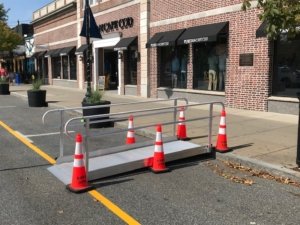
When the Town of Barnstable allowed restaurants to expand their outdoor seating onto public sidewalks to help keep businesses afloat during difficult times, the change unintentionally created barriers for people who use mobility devices. The expanded seating blocked the path of travel from curb cuts, preventing many individuals from moving safely along the sidewalk.
CORD responded immediately by assessing the situation and working with the Town to identify solutions. Barnstable agreed to install portable ramps at all affected locations so that everyone—regardless of mobility needs—could continue to shop and move through the area safely.
CORD also contacted other towns across the region, urging them to watch for similar access issues and offering free technical assistance to help prevent barriers before they occur.
Ban plastic straws? Not so fast….. 
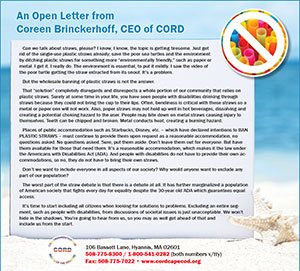
While we recognize that single-use plastic straws pose environmental challenges, an outright ban can negatively affect many individuals who rely on them for safe hydration. Although alternatives exist, many of them present risks for people with certain access or functional needs.
CORD has taken an active role in educating the public—through social media and traditional media—about the unintended consequences a full ban can create. A CORD manager attended a Board of Health meeting in Sandwich to testify against a proposed ban and is prepared to speak at meetings in any community considering similar measures.
The ADA works. Leave it alone!
Each year, new legislation is introduced that could weaken protections established under the Americans with Disabilities Act (ADA), and 2018 was no exception. Congress passed the ADA Education and Reform Act, but the Senate declined to bring it to a vote. Before the mid-term elections, there was concern that the Senate might attach the bill to other legislation and advance it before newly elected senators took office in January.
CORD acted quickly by educating the public about the harmful impact this bill would have on people who rely on the ADA’s protections. We mobilized our community, encouraging individuals to participate in a letter-writing campaign urging Senator Warren and Senator Markey to stand firm in support of the ADA and reject any legislation that would undermine its guarantees.
State law and ADA don’t match? That’s a problem.
Did you know that a business can fully comply with Massachusetts access laws and still be out of compliance with the ADA? CORD has partnered with advocacy groups across the state to encourage Massachusetts Architectural Access regulations to better align with federal standards. This alignment benefits individuals who face access barriers—and it also supports businesses by providing clearer, more consistent requirements.

Actually, voting does matter.
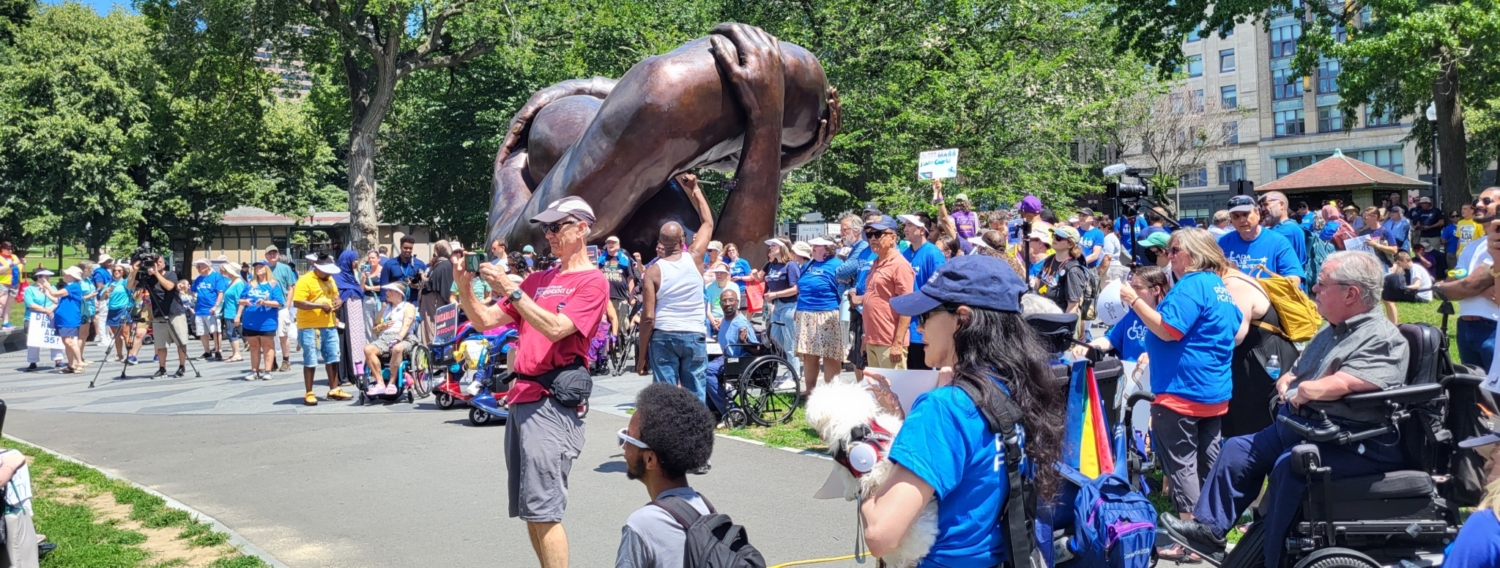
Many factors can make voting challenging, but states have been working to improve participation through absentee voting, early voting, and equipment designed to support a wider range of voters. Still, none of these efforts matter if people are not registered. CORD has joined the REV UP movement to help increase voter registration among individuals who experience functional or participation challenges. By hosting registration events, using social media to highlight the importance of voting, and offering direct assistance to those who want to register, CORD has been working hard to help more people take the crucial first step toward civic engagement.
But registering is only the beginning. Polling locations must also work for all voters. In recent years, CORD has collaborated with the Massachusetts Disability Law Center (DLC) to help ensure that polling sites on Cape Cod meet required federal standards. This year alone, CORD advocates reviewed 20 polling locations—examining physical features, ballot formats, availability of voting information, and the functioning of federally required voting machines designed for individuals who cannot read printed ballots. We also devote significant time to educating the community about their rights under federal voting laws, including the ADA.
Same old story… not enough money to go around.
Every year, essential services and programs that people rely on face flat funding or cuts. And every year, CORD steps forward—calling legislators, attending rallies and State House meetings, and advocating to protect and strengthen these supports. Whether the issue involves housing vouchers, MassHealth, or community-based services, CORD is there fighting for individuals who face access or functional barriers throughout the Cape and Islands.
Helping to improve PCA services.
CORD has played a leading role in strengthening PCA services, helping establish the PCA Workforce Council, improving transportation options, and expanding affordable housing opportunities — including advocating for the creation of the state’s Home Modification Program.
Helped establish the CommonHealth insurance program.
One of CORD’s most significant accomplishments in its early years was leading the effort that created CommonHealth — the nation’s first Medicaid buy-in program for individuals who would otherwise lose essential medical coverage if they earned income.
At a 1986 meeting, CORD member Paula Burns explained that if she accepted employment, her income would make her ineligible for Medicaid, which covered critical services that no private insurance plan offered at the time. She faced an impossible choice: work and lose coverage, or keep coverage but be unable to work. In effect, she was penalized for wanting a job.
Recognizing the urgency, CORD partnered with the Cape Advocacy Center and Health Care for All to develop a solution. Their work led to the creation of CommonHealth, which became law on July 1, 1988. A memorable moment in the campaign was the 1987 “Let Us Get to Work!” rally at the State House, where more than 300 people gathered to demand change.
CommonHealth became the prototype for Medicaid buy-in programs nationwide, giving thousands of individuals with significant ongoing medical support needs the ability to work without losing vital health coverage.
Battled in Washington for the Americans with Disabilities Act.
In 1989, CORD began a strong, decade-long partnership with the national civil rights organization ADAPT. CORD members took part in key national actions supporting the passage of the Americans with Disabilities Act (ADA), including the well-known 1989 demonstration at Philadelphia’s Liberty Bell, the 1990 Capitol Crawl in Washington, D.C., and the historic meeting in the Capitol Rotunda with Congressional leaders. These events—culminating in acts of civil disobedience—were later featured in the PBS documentary Lives Worth Living, which chronicles the national fight for equal rights and access.
Health care activism: getting doctors to accept Medicare and Medicaid.
CORD has long been active in health-care advocacy. Working alongside Dick Bigos and the Community Action Committee (CAC), Bill Pastreich and the Hospital Workers Union, and Mabel Canto and Cape United Elderly, the organization fought to ensure that people covered by Medicaid and Medicare could access medical providers without discrimination.
This effort included formal hearings and a highly visible 1985 protest in which CORD and partner organizations took over a Massachusetts Medical Society meeting in Hyannis to demand fair treatment and equal access to care. These actions contributed to subsequent rulings and legislative changes that helped remove long-standing barriers to essential health services.
Improving opportunities for full participation on Cape Cod.
CORD played an active role in advancing local access policies, including supporting the adoption of a strengthened accessible parking bylaw in Barnstable—an effort championed by Bernie Woodman—expanding B-Bus service hours for weekends and evenings (which, until about 1986, operated fewer than eight hours a day for only five days a week), and addressing widespread architectural barriers across the region.
In 1985, nine CORD members carried out a coordinated action in downtown Falmouth, encouraged by Mike Early and Louis Copestick. Using mobility devices, they attempted to cross the street but were prevented from doing so by the absence of a required curb cut on the far side, a clear violation of state design standards. Their halted movement, occurring during peak summer traffic, created a significant backup that drew considerable media attention. The resulting public focus prompted Falmouth to implement major structural improvements and helped spark broader advocacy efforts throughout Cape Cod.
Many individuals and organizations contributed to CORD’s progress over the years, including civil rights leaders and community partners such as Leo Lucas, Rick McIntosh, Melva Wood Johnson, Fred Zepernick, Kent Killiam, Alicia Walinski, Senator Lois Pines, Representative Tom Cahir, Pam Burkley, Betty Lynch, Lisa Canto, Jim Gleich, Michael Marcus, Pat Ford, Arthur Wood, Debbie Talshir, Kathleen Kelleher, Patty Rodriques, Jim Heffernan, Autumn Daniels, Mike Newhall, Felicity Craven, and Skip Nelson. We extend sincere apologies to anyone inadvertently not mentioned.